
Upcycle Your Clothes and Household Items with these Donation and Recycling Resources
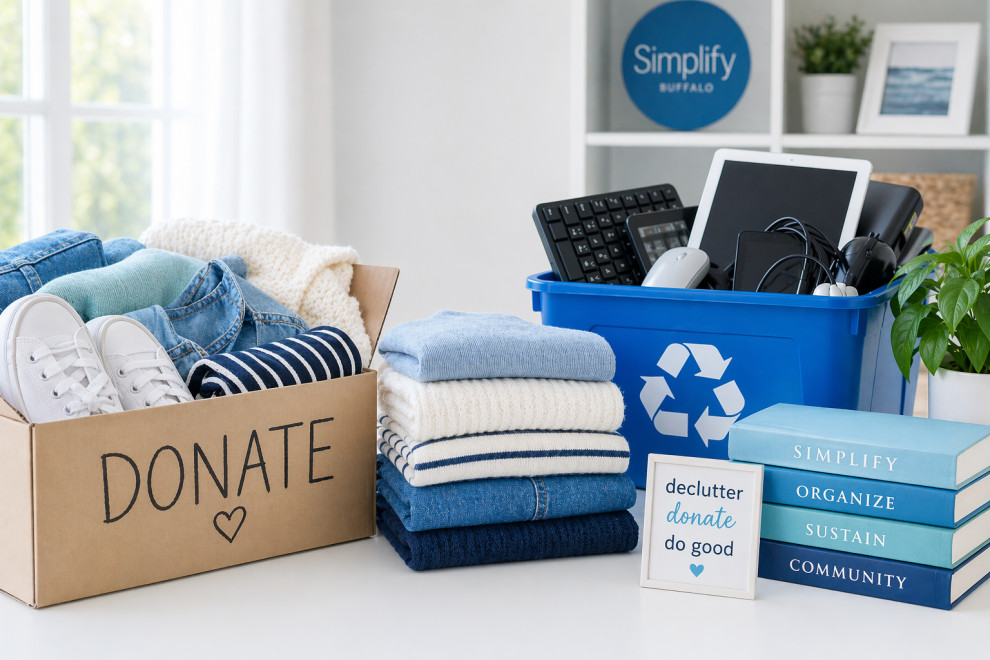
Interestingly, most people don't struggle with deciding what to keep as part of decluttering; they struggle because they do not know what to do with the things they are ready to let go of.
That is especially true with clothing and household items...
You clean out a closet, gather a pile of extra linens, find old electronics in a drawer, or finally admit the toy overflow has taken over the house.
Then everything stalls.
The donate pile sits in your entryway.
The recycling pile moves to the trunk.
The “I’ll deal with it later” pile quietly becomes a new category of clutter.
That is exactly why we created our Buffalo and Western New York donation and recycling resource guides, so decluttering does not stop at the pile stage.
When you already know where things can go, it becomes much easier to let go in the first place.
You are not just getting rid of things. You are giving useful items a next step. A helpful mantra for this process is:
Do not store what could still serve someone else.
Below are five practical habits that make it easier to upcycle your clothes and household items with these donation and recycling resources, along with local operators who are currently accepting donations.
1. Make “where will it go?” part of the decluttering decision
A lot of people ask themselves one question when they declutter: "Do I want this?"
That is not a bad question, but it is often incomplete.
A more useful version is: "Do I use this, and if not, where should it go next?"
That second question changes everything. It moves you out of guilt and into action.
Household goods, small appliances, and furniture may be better suited for organizations like Gerard Place, Habitat for Humanity ReStore, or Upward Design.
Extra baby gear might be more useful to a family resource organization than in your guest room. Outgrown children’s clothing and shoes can be donated to WNY Foster Closet, Rainie’s Foster Closet, Wear N’ Share, or Harvest House.
Old books, tools, pet supplies, or sports equipment may each have a better destination, like your local library, rather than a generic donation drop-off.
This approach also helps with the harder categories. If you are holding onto old cords, broken appliances, leftover paint, worn towels, or half-working electronics, it may be less about emotional attachment and more about not knowing the proper outlet. In Buffalo and Western New York, there are often local recycling events and specialty drop-off options that make it easier to deal with these items responsibly. Be sure to follow us on social media, especially Instagram, where we often share local events and recycling opportunities like these.
Once you have a trusted recycling resource list, those decisions get lighter.
Try this simple filter when deciding if it is time to let go:
- You have not used it in a long time and realistically will not soon
- It no longer fits your space, your routines, or your current season of life
- You already own something else that does the job better
- Keeping it creates more stress than value
- You would not buy it again today
That last one is sneaky, but effective.
2. Sort by exit path, not by room
One mistake that slows people down is sorting everything by where it came from instead of where it is going.
When you are ready to upcycle your clothes and household items with these donation and recycling resources, your home gets easier to manage if you create outgoing categories like these:
- Clothing and shoes to donate
- Household items to donate
- Textiles to recycle
- Electronics to recycle
- Paper, shredding, or specialty recycling
- Trash
This is much more functional than making separate piles for the bedroom, mudroom, basement, and kitchen.
Why? Because most clutter does not leave your house room by room. It leaves by destination.
For example, a Buffalo family doing a spring reset may gather outgrown rain boots from the mudroom, extra towels from the linen closet, unopened toiletries from the bathroom, and old laptops from the office into one category. Those items did not come from the same space, but they should not be handled the same way either.
Once you sort by exit path, it becomes much easier to use local resources well.
Clothing can go to one place...
Electronics can go somewhere else...
Household donations can go to an organization that truly wants those items.
Suddenly, the whole project feels less like one giant vague errand and more like a few very clear ones.
3. Keep one small “outgoing basket” active all the time
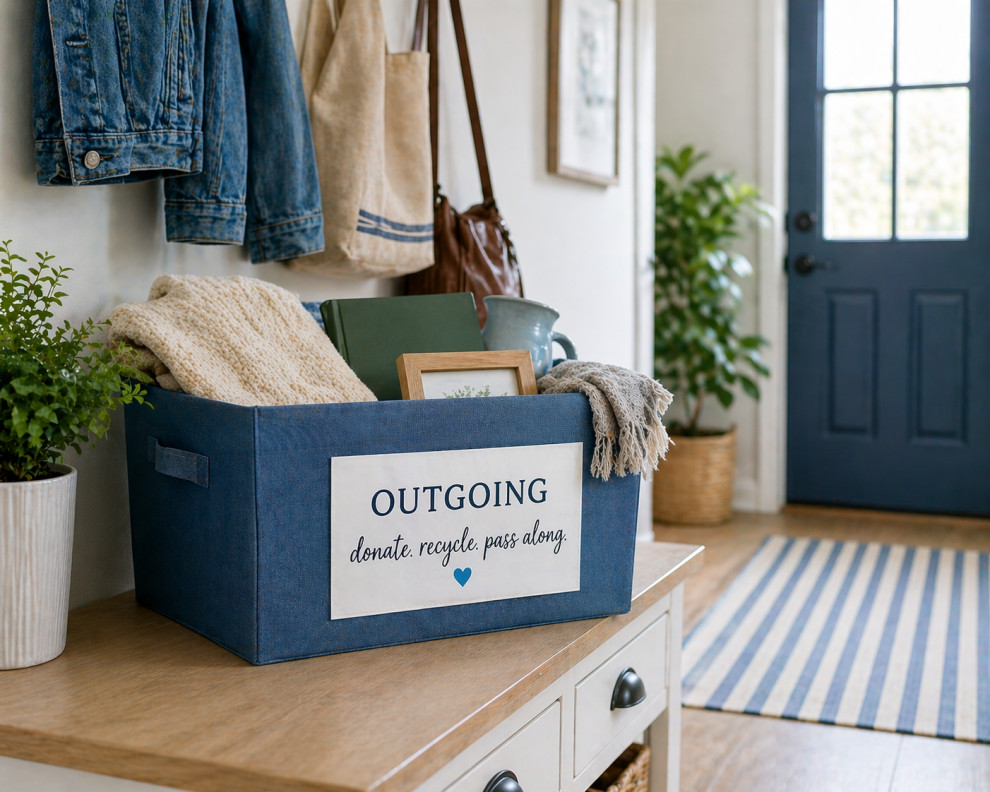
Not every decluttering task needs to begin with a full cleanout.
One of the smartest ways to maintain momentum is to keep one designated outgoing basket, bag, or bin somewhere convenient. A mudroom closet, laundry room shelf, or tucked-away spot in a pantry works well.
This is where you place good items that no longer belong in your home as you come across them.
Think of it as your holding zone for responsible letting go.
This works especially well for real-life items that show up gradually:
- A shirt your child has outgrown this week
- A set of mugs you never reach for
- A candle that was a nice gift, but not your style
- Duplicate pantry containers
- A throw pillow that no longer works after a room refresh
The key is to keep the container small.
You do not want a giant donation mountain. You want a manageable signal that it is time for a drop-off.
For busy households in Western New York, this habit is often more sustainable than waiting for a once-a-season purge. It keeps clutter from building quietly in closets and corners, and it makes decluttering feel like part of normal home life instead of a dramatic event.
4. Match the item to the right local resource
One of the smartest ways to keep decluttering moving is to stop treating every outgoing item the same. A bag of children’s clothes should not go to the same place as old paint, and extra tools should not get tossed into a random donation pile just because they are still usable.
When you match the item to the right local resource, it becomes much easier to let go because you already know its next stop.
The best resource lists help you make better decisions faster. Instead of dropping everything at the nearest bin and hoping for the best, you can direct items more intentionally.
A few of my go-to Buffalo and Western New York donation and recycling resources:
- Children’s clothing, coats, and shoes: WNY Foster Closet, Rainie’s Foster Closet, Wear N’ Share, Harvest House
- Household items and small appliances: Gerard Place, Habitat for Humanity ReStore, Friends of the Night People
- Tools: Buffalo Tool Library
- Sports equipment: Level the Playing Field
- Educational textbooks: Textbooks Buffalo
- Pet supplies, blankets, and towels: ASPCA
- Eyeglasses and hearing aids: Lions Club
- Technology and electronics: Mission Ignite, Sunnking, Erie County, HAZMAN, Call2Recycle (depending on item type)
- Paint: PaintCare or Erie County
- Paper recycling or shredding: Abitibi Paper Retriever and UPS Store for shredding
- Worn-out clothing, shoes, linens, bedding, and accessories: Trashie Bags or Hearts for the Homeless (depending on condition)
This matters because it reduces hesitation. People tend to let go more easily when they feel confident that an item is actually going somewhere appropriate.
It also helps reduce the “just in case” trap. You do not need to keep an old printer, a stack of blankets, or extra kitchenware just because throwing it away feels wasteful.
If your resource list shows there is a better path, you can move forward.
5. Finish the cycle with a weekly release habit
The final step is the one that makes all the difference: schedule the exit.
A donation pile is not progress forever. At some point, it needs to leave the house.
Create a simple weekly release habit. It does not need to be elaborate. Tie it to something that already happens:
- Add one donation stop to your normal Saturday errands
- Keep a small bag in the car for approved drop-offs
- Choose one day a month for electronics or specialty recycling
- Save our local resource PDF to your phone so you can act on it when you are already out
This is where a lot of homes in Buffalo get stuck, especially during seasonal transitions. One day it feels like spring, the next day it feels like winter again, and the house ends up holding layers of clothing, gear, and household overflow from every possible weather scenario. Without a regular release habit, those in-between items start taking up permanent space.
A better goal is not to have less for the sake of less. It is to keep only what fits your home right now and move the rest along responsibly.
That is the real value in learning to upcycle your clothes and household items with these donation and recycling resources. It gives your decluttering efforts a true ending point.
Less Waste, Less Clutter, More Breathing Room
Decluttering gets much easier when you stop thinking only about what is leaving and start thinking about where it can go next. That shift makes the process feel more practical, more sustainable, and a lot less emotionally sticky.
If you want to upcycle your clothes and household items with these donation and recycling resources, the goal is not perfection. It has a simple system that helps good items leave your home with purpose.
Remember the mantra:
Do not store what could still serve someone else.
That is a smarter way to declutter, and it is one that works especially well for busy families and professionals trying to keep life manageable in Buffalo and Western New York.