
How to Pack Your Kitchen for a Move (Without Breaking Your Plates)
Certain rooms in your home feel annoying to pack for a move. Then there is the kitchen.
You open one cabinet and realize you own seventeen coffee mugs, six oddly shaped serving bowls, wine glasses you forgot about, and a collection of baking dishes that somehow multiplied over the years.
Suddenly, the room that looked manageable feels like a game of Tetris where everything is fragile.
For families and homeowners around Buffalo and Western New York, moving often happens during already busy seasons. Kids are finishing school, sports schedules are packed, or perhaps you are trying to coordinate a move while juggling work and everyday life. Kitchen packing tends to become the "we'll figure it out later" category.
The problem is that kitchens are not difficult because of the number of items. They are difficult because of the variety of items. You are packing plates, heavy cookware, delicate glassware, random utensils, pantry items, and oddly shaped serving pieces all in one room.
The good news is that learning how to pack your kitchen for a move without breaking your plates is less about expensive packing supplies and more about creating structure before things ever go into a box.
Here are five practical strategies we use that make kitchen packing faster, more organized, and much less likely to end with shattered dishes.
1. Use packing paper as an organizing tool, not just a protective one
Most people think of packing paper as bubble wrap's less-exciting cousin.
But packing paper does more than prevent scratches.
Think of it as a way to create mini groups inside your boxes.
Instead of tossing loose measuring spoons, serving utensils, or random kitchen gadgets into a box, bundle related items together inside one sheet of paper.
Examples:
- Wrap all measuring cups and spoons together
- Bundle silverware by category
- Keep baking tools together
- Group kids' lunchbox accessories into one package
- Wrap coffee accessories separately from mugs
When unpacking, you are opening organized categories instead of digging through mystery boxes.
This also keeps small items from shifting and disappearing into the corners of larger boxes.
2. Stop trying to "finish the cabinet."
This is one of the biggest kitchen packing mistakes we see.
People often think: "Let me empty this entire cabinet into one box."
The result usually looks like this:
- Heavy bowls mixed with glasses
- Kitchen gadgets piled on top
- One giant box nobody can lift
- Random categories mixed together
Instead, think smaller.
Use more boxes than you think you need and pack by category rather than cabinet location.
For example:
Box 1
- Dinner plates
- Salad plates
- Bowls
Box 2
- Baking supplies
- Measuring tools
- Mixing bowls
Box 3
- Coffee mugs
- Travel mugs
- Coffee accessories
Yes, you may use more boxes. No, this is not wasteful.
Smaller organized boxes reduce shifting during transport and make unpacking dramatically easier. Your future self will thank you when you are trying to make coffee on moving day instead of searching through six boxes labeled "Kitchen Misc." 🤞
3. Pack plates like records, not pancakes
This tip surprises almost everyone.
Most people naturally stack plates flat because that is how we store them in cabinets.
It is not the safest way to move them.
When plates are stacked flat, the weight presses directly downward. Every bump in the moving truck transfers pressure through the stack.
Instead:
- Wrap each plate individually with packing paper
- Add padding between plates
- Place plates vertically on their sides, like records in a record collection
- Put heavier dinner plates at the bottom of the row
- Fill empty space around the edges
The pressure distributes differently and helps reduce cracking. The same approach works for bowls, too. Think library books, not pancakes.
4. Give stemware special treatment
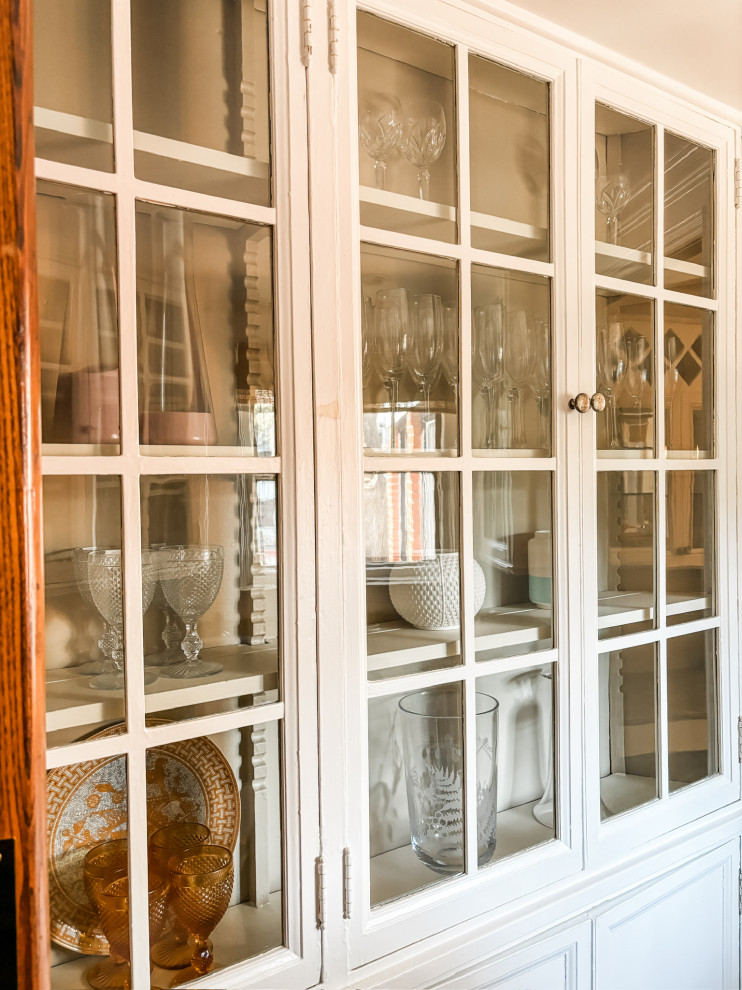
Wine glasses and stemware are usually where people start getting nervous.
For good reason.
The stem is often the weakest point.
For stemware:
- Wrap the stem separately with extra reinforcement
- Then wrap the bowl portion
- Use dividers whenever possible
- Pack glasses upright or upside down, never on their sides
- Keep glasses from touching directly
If needed, alternate one up and one down to maximize space, but avoid packing tightly.
A common mistake is trying to fit "just one more glass." The goal is not maximum capacity.
The goal is to arrive with the same number of glasses you started with.
5. Think in stacks and systems for bowls and baking dishes
Mixing bowls and baking dishes can feel awkward because they are bulky and heavy.
But these categories actually pack very efficiently when approached as systems.
Glass mixing and serving bowls
Instead of wrapping every bowl separately:
- Nest bowls from largest to smallest
- Add packing paper or bubble wrap between each layer
- Wrap the full stack together as one unit
- Place the stack upright in the box
- Pad all sides
- Keep heavy items away from the top
Pyrex and baking dishes
Glass baking dishes deserve extra attention because corners and handles are common break points.
For dishes like Pyrex or Corelle:
- Wrap each piece individually
- Add extra reinforcement around corners and handles
- Stand dishes on their sides whenever possible
- Avoid stacking heavy dishes directly on top of each other
- Fill space so dishes cannot shift
A moving truck has a lot of vibration. Empty space inside boxes becomes movement, and movement becomes damage.
Wrapping It Up
Moving is already enough of a mental load without opening a kitchen box and hearing that unmistakable sound of broken dishes.
When thinking about how to pack your kitchen for a move without breaking your plates, focus less on packing quickly and more on creating simple systems. Use packing paper to organize, pack smaller category-based boxes, and pay attention to how fragile items are positioned.
The goal is not perfection.
The goal is opening your new kitchen in Buffalo or Western New York and feeling like unpacking is manageable instead of overwhelming.
Because after moving day, nobody wants to be eating cereal out of measuring cups for the next week.